

The Americans have officially renamed artificial intelligence to 'Super Intelligence,' which should fix everything
Yup, it's real. They did it.
Here's the full executive order, if you want to take it all in. Pity poor Sports Illustrated.
It's laughable, up there with similarly demented efforts to rename the Gulf of Mexico, Lake Ontario, and maybe New Mexico—I guess we'll see how that one ultimately shakes out. It's also pretty funny how "super intelligence" jibes with "Super Earth," the fascist homeworld of humanity in Helldivers 2. Probably just a coincidence, though.
Yet somehow, I'm not inclined to laugh. That the leader—ruler, really, at this point—of the most powerful nation on the planet can just whip out bizarre ideas like this and have them treated seriously is kind of frightening, isn't it?
And it is being taken seriously, at least insofar as we can describe billionaire tech oligarchs lining up to say and do pretty much whatever it takes to keep juicing the share price as seriousness: A subsequent White House Accord on Super Intelligence was signed by a who's-who of people who have made PC gaming almost impossibly expensive:
- Sundar Pichai (Google)
- Dario Amodei (Anthropic)
- Mark Zuckerberg (Meta)
- Greg Brockman (OpenAI)
- Elon Musk (XAI)
- Jensen Huang (Nvidia)
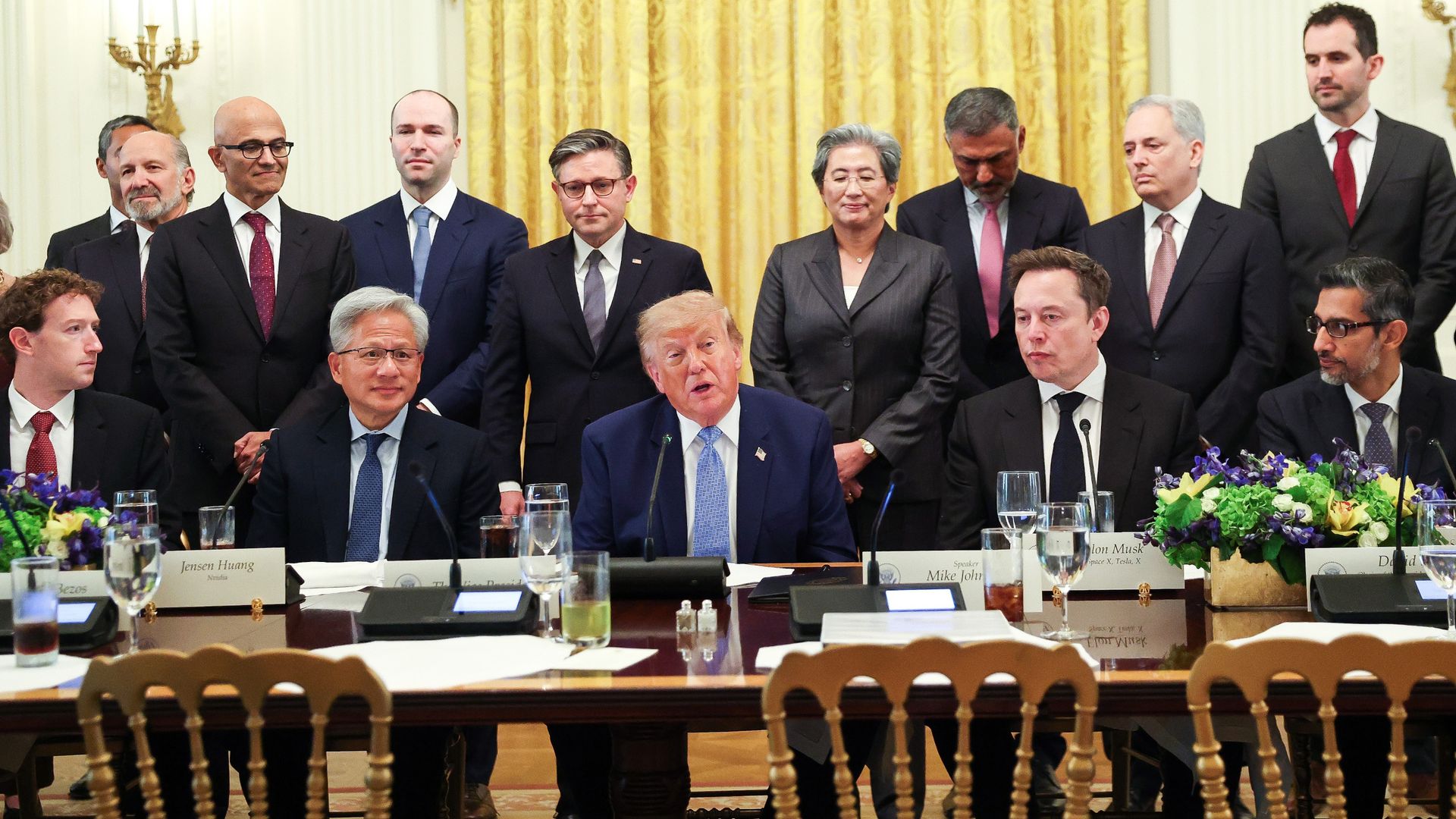
And yes, they actually misspelled United States as "Unites States" under Trump's signature. Real pros at work here, top men all around.
Musk wasted no time publicly endorsing the rebranding on his X platform, although he was back to calling it AI less than eight hours later.
Super Intelligence https://t.co/ijlPkAmDBkSeptember 29, 2026
Huang also signalled his obedience, referring to "super intelligence" no fewer than three times in his own X post.
Yesterday at the White House, leaders from across our industry came together to sign the White House Accord on Super Intelligence.The principle is simple: the companies building this technology have the primary responsibility to develop and deploy it safely, and to be… pic.twitter.com/RGMDYs9bhsSeptember 30, 2026
Pichai, who was quick to acquiesce to Trump's demand to rename the Gulf of Mexico and Lake Ontario for US users of Google Maps, heaped praise on the heads of the administration while also trotting out the phrase.
Great to meet today with @POTUS, @JDVance, @SpeakerJohnson and Administration + tech leaders. Important conversation and we signed today the White House Accord on Super Intelligence.As I shared today, Google has invested hundreds of billions in the last two years alone, with… pic.twitter.com/04EirBfyUXSeptember 30, 2026
And of course so did Zuckerberg, but on his own Facebook platform: "We believe superintelligence will create significant new opportunities for all people and businesses."
Humiliating prostrations notwithstanding, the practical impact of renaming artificial intelligence is basically nil: Apart from White House sycophants and quisling MAGA press outlets, nobody's calling it that.
But the bigger-picture consequences may be more, well, consequential: The accord, signed shortly after all the techbro billionaires lined up dutifully in a show of support for the latest addition to the president's world-changing "legacy," leaves the AI industry to regulate itself—"tremendous self-regulation," as Trump put it.
To quote from the accord: "In order to build a positive future for the American people and the world, we believe every company is responsible for developing its own technology safely and in a way that builds trust with customers and the public." It later states that "participating companies will meet regularly to establish standards and best practices to improve the safety of their systems." No mention of regulatory oversight, or any government involvement at all, is made.
Official. pic.twitter.com/BoTuIhxbTgSeptember 29, 2026
At least one big-name tech billionaire spoke out against the idea of self-regulation for the AI industry, although it bears remembering that he's not beholden to shareholders anymore.
"It’s fair to say that outside of the industry, the awareness of the dangers of A.I. is extremely low," Microsoft co-founder Bill Gates told the New York Times. "And you can say that of academia, you can say that of think tanks, you can say that of policymakers, politicians.
"And part of the reason I’m speaking so loudly—as loud as I can—is that you can’t rely on the industry to self-regulate here. I mean, it’s just insane."
So I guess, taking all that in, it's not really all that funny after all. But it sure is super.
2026 games: All the upcoming games
Best PC games: Our all-time favorites
Free PC games: Freebie fest
Best FPS games: Finest gunplay
Best RPGs: Grand adventures
Best co-op games: Better together
from Latest from PC Gamer https://ift.tt/Tmat53Z
Yup, it's real. They did it.
Here's the full executive order, if you want to take it all in. Pity poor Sports Illustrated.
It's laughable, up there with similarly demented efforts to rename the Gulf of Mexico, Lake Ontario, and maybe New Mexico—I guess we'll see how that one ultimately shakes out. It's also pretty funny how "super intelligence" jibes with "Super Earth," the fascist homeworld of humanity in Helldivers 2. Probably just a coincidence, though.
Yet somehow, I'm not inclined to laugh. That the leader—ruler, really, at this point—of the most powerful nation on the planet can just whip out bizarre ideas like this and have them treated seriously is kind of frightening, isn't it?
And it is being taken seriously, at least insofar as we can describe billionaire tech oligarchs lining up to say and do pretty much whatever it takes to keep juicing the share price as seriousness: A subsequent White House Accord on Super Intelligence was signed by a who's-who of people who have made PC gaming almost impossibly expensive:
- Sundar Pichai (Google)
- Dario Amodei (Anthropic)
- Mark Zuckerberg (Meta)
- Greg Brockman (OpenAI)
- Elon Musk (XAI)
- Jensen Huang (Nvidia)
And yes, they actually misspelled United States as "Unites States" under Trump's signature. Real pros at work here, top men all around.
Musk wasted no time publicly endorsing the rebranding on his X platform, although he was back to calling it AI less than eight hours later.
Super Intelligence https://t.co/ijlPkAmDBkSeptember 29, 2026
Huang also signalled his obedience, referring to "super intelligence" no fewer than three times in his own X post.
Yesterday at the White House, leaders from across our industry came together to sign the White House Accord on Super Intelligence.The principle is simple: the companies building this technology have the primary responsibility to develop and deploy it safely, and to be… pic.twitter.com/RGMDYs9bhsSeptember 30, 2026
Pichai, who was quick to acquiesce to Trump's demand to rename the Gulf of Mexico and Lake Ontario for US users of Google Maps, heaped praise on the heads of the administration while also trotting out the phrase.
Great to meet today with @POTUS, @JDVance, @SpeakerJohnson and Administration + tech leaders. Important conversation and we signed today the White House Accord on Super Intelligence.As I shared today, Google has invested hundreds of billions in the last two years alone, with… pic.twitter.com/04EirBfyUXSeptember 30, 2026
And of course so did Zuckerberg, but on his own Facebook platform: "We believe superintelligence will create significant new opportunities for all people and businesses."
Humiliating prostrations notwithstanding, the practical impact of renaming artificial intelligence is basically nil: Apart from White House sycophants and quisling MAGA press outlets, nobody's calling it that.
But the bigger-picture consequences may be more, well, consequential: The accord, signed shortly after all the techbro billionaires lined up dutifully in a show of support for the latest addition to the president's world-changing "legacy," leaves the AI industry to regulate itself—"tremendous self-regulation," as Trump put it.
To quote from the accord: "In order to build a positive future for the American people and the world, we believe every company is responsible for developing its own technology safely and in a way that builds trust with customers and the public." It later states that "participating companies will meet regularly to establish standards and best practices to improve the safety of their systems." No mention of regulatory oversight, or any government involvement at all, is made.
Official. pic.twitter.com/BoTuIhxbTgSeptember 29, 2026
At least one big-name tech billionaire spoke out against the idea of self-regulation for the AI industry, although it bears remembering that he's not beholden to shareholders anymore.
"It’s fair to say that outside of the industry, the awareness of the dangers of A.I. is extremely low," Microsoft co-founder Bill Gates told the New York Times. "And you can say that of academia, you can say that of think tanks, you can say that of policymakers, politicians.
"And part of the reason I’m speaking so loudly—as loud as I can—is that you can’t rely on the industry to self-regulate here. I mean, it’s just insane."
So I guess, taking all that in, it's not really all that funny after all. But it sure is super.
2026 games: All the upcoming games
Best PC games: Our all-time favorites
Free PC games: Freebie fest
Best FPS games: Finest gunplay
Best RPGs: Grand adventures
Best co-op games: Better together
via IFTTT

Post a Comment